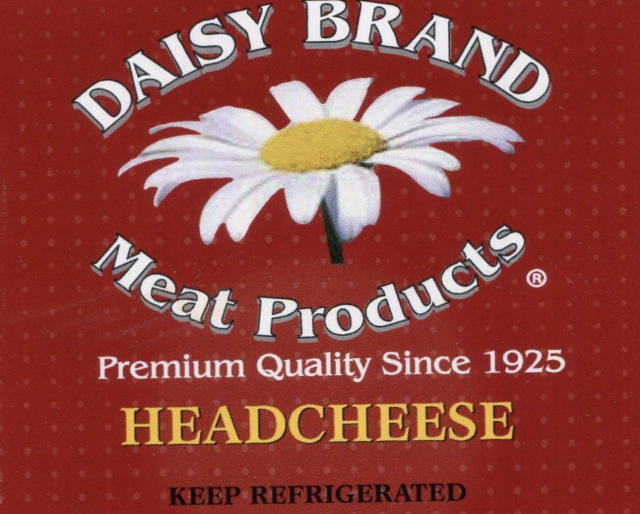
The U.S. Department of Agriculture’s Food Safety and Inspection Service (FSIS) is issuing a public health alert for headcheese that may be contaminated with Listeria monocytogenes (Lm). A recall was not requested because the products are no longer available for purchase. Headcheese is a ready-to-eat (RTE), pork deli meat product typically made from meat and seasonings that are cooked together and formed into a loaf or jelly-style product.
The fully cooked pork headcheese products were produced on January 20, 2026. These products are intended for slicing at retail delis and some deli purchases may only show the producer’s brand without the affected date. The following products are subject to the public health alert [view labels]:
- Various weight packages packed or sliced in retail delis, containing “DAISY BRAND Meat Products HEADCHEESE,” with a “USE BY” date of “MAR 26 2026.”
- Various weight packages packed or sliced in retail delis, containing “DAISY BRAND Meat Products HEADCHEESE,” with a red sticker indicating “HOT” and a “USE BY” date of “MAR 26 2026.”
The products bear establishment number “EST. 21406” inside the USDA mark of inspection. These items were distributed to retail deli locations in Illinois and Indiana.
The problem was discovered as part of an ongoing illness outbreak investigation. FSIS, the Illinois Department of Public Health, and local health departments in Illinois are investigating a localized outbreak of Lm that includes three sick people in Illinois. Because the outbreak is contained within the state, Illinois is leading this investigation with FSIS. FSIS continues to keep its federal partners at the Centers for Disease Control and Prevention informed as the investigation progresses. FSIS collected an unopened headcheese product sample that tested positive for Lm. Further testing is ongoing to determine if the product samples are related to the specific outbreak strain.
FSIS is concerned that recently purchased product may remain in consumer refrigerators. Consumers who have purchased these products are urged not to consume them. These products should be thrown away or returned to the place of purchase. Consumers who have purchased these products are also urged to clean refrigerators thoroughly to prevent the risk of cross-contamination.
Consumption of food contaminated with Lm can cause listeriosis, a serious infection that primarily affects older adults, persons with weakened immune systems, and pregnant women and their newborns. Less commonly, persons outside these risk groups are affected.
Listeriosis can cause fever, muscle aches, headache, stiff neck, confusion, loss of balance and convulsions sometimes preceded by diarrhea or other gastrointestinal symptoms. An invasive infection spreads beyond the gastrointestinal tract. In pregnant women, the infection can cause miscarriages, stillbirths, premature delivery or life-threatening infection of the newborn. In addition, serious and sometimes fatal infections can occur in older adults and persons with weakened immune systems. Listeriosis is treated with antibiotics. Persons in the higher-risk categories who experience flu-like symptoms within two months after eating contaminated food should seek medical care and tell the health care provider about eating the contaminated food.
Headcheese (also called brawn, souse, or fromage de tête) is a cold cut — but despite the name, it isn’t actually cheese. It’s a meat jelly or terrine traditionally made from the head of a pig (sometimes a calf or sheep), set in its own natural gelatin.
Headcheese has been implicated in a deadly Listeria outbreak in the past:
Outbreak of Invasive Listeriosis Associated with the Consumption of Hog Head Cheese — Louisiana, 2010
April 8, 2011 / 60(13);401-405

During January–June 2010, a total of 14 cases of laboratory-confirmed invasive listeriosis were reported to the Louisiana Office of Public Health (OPH). Isolates of Listeria monocytogenes from the blood samples of eight patients were identified as serotype 1/2a and had pulsed-field gel electrophoresis (PFGE) pattern combinations that were indistinguishable from one another. The detection of this cluster prompted an investigation in coordination with CDC, the Louisiana Department of Agriculture and Forestry (LDAF), and the U.S. Department of Agriculture’s Food Safety and Inspection Service (USDA-FSIS). In-depth epidemiologic and environmental investigations of the cluster were initiated on July 26, including food history interviews of four patients. Three patients reported eating hog head cheese (a meat jelly made from swine heads and feet); the product was purchased at two grocery stores in Louisiana. A traceback investigation determined that a single brand of hog head cheese was common between the two grocery stores. L. monocytogenes serotype 1/2a was cultured from one of three product samples and from two of 16 environmental samples collected by LDAF at the processing establishment; the product and one of the two environmental samples yielded isolates with PFGE pattern combinations that were indistinguishable from the patient isolates. On August 14, LDAF coordinated a voluntary recall of approximately 500,000 pounds of hog head cheese and sausage because of possible contamination with L. monocytogenes. This is the first published report of an invasive listeriosis outbreak associated with hog head cheese, which is a ready-to-eat (RTE) meat. USDA-FSIS has a “zero tolerance” policy for L. monocytogenes contamination of RTE food products (1), requesting recall of such products at any detectable level of L. monocytogenes contamination. LDAF imposes and enforces equivalent requirements in state-inspected establishments.
Invasive listeriosis has been nationally notifiable since 1999. In 2003, the Council of State and Territorial Epidemiologists recommended prompt, routine interviews of all patients using a standardized questionnaire and forwarding all L. monocytogenes isolates from clinical laboratories for PFGE subtyping at public health laboratories (2). Accordingly, the Louisiana OPH collects demographic and clinical information for all reported cases of invasive listeriosis. Patients are interviewed immediately for food histories using CDC’s Listeria Initiative questionnaire.* Patient isolates are sent to the Public Health Central Laboratory at OPH for confirmation and PFGE characterization.
Louisiana OPH epidemiologists noted that 14 cases of invasive listeriosis had been reported during January–June 2010, which exceeded the state’s average of five cases reported during each January–June period during the previous 3 years. For this investigation, a cluster-associated case was defined as isolation of L. monocytogenes serotype 1/2a from a normally sterile site (e.g., blood or cerebrospinal fluid) or from placental or fetal tissue (in the setting of miscarriage or stillbirth) since January 1, 2010, and PFGE pattern combination GX6A16.0001 and GX6A12.0001.
Eight patients had illnesses that met the case definition. Their median age was 64 years (range: 38–93 years). Six patients were men; no patients were pregnant. Six patients had one or more underlying medical conditions (i.e., human immunodeficiency virus [HIV] infection, alcohol abuse, cancer, and diabetes mellitus). Illness onsets occurred from February 18 to June 16 (Figure). Signs and symptoms included fever (n = 6 patients), altered mental status (n = 3), diarrhea (n = 3), vomiting (n = 3), and weakness (n = 2). Seven patients were hospitalized; two patients died.
OPH epidemiologists obtained food histories from four patients; the remaining patients could not be reached for interview because of their illness or death. Two patients initially reported eating hog head cheese purchased from the same grocery store. Upon re-interview, a third patient also reported eating hog head cheese purchased from a grocery store in another city. A fourth patient could not be reached for re-interview but had initially reported eating “other deli meats,” a category that would include hog head cheese. The traceback investigation determined that only one brand of hog head cheese was sold at both stores, suggesting that this brand was the outbreak source.
OPH sanitarians conducted an environmental investigation at both grocery stores to gather additional information on the suspect product. The sanitarians determined that hog head cheese offered for sale arrived in small, 0.7 pound blocks that were individually vacuum-sealed at the processing establishment. Each store weighed and priced the product and sold it in the refrigerated meat section. The sanitarians collected one unopened package of mild hog head cheese from the first store and two unopened packages of hog head cheese, one mild and one spicy, from the second store. At CDC’s Enteric Diseases Laboratory Branch, L. monocytogenes serotype 1/2a with the outbreak PFGE pattern combination was isolated from the package of spicy hog head cheese.
This finding triggered a voluntary recall of approximately 500,000 pounds of hog head cheese and sausage that was processed on the same equipment. LDAF also collected 16 environmental samples from the processing establishment. Cultures of samples from a refrigeration unit and a door threshold yielded L. monocytogenes. An isolate from the refrigeration unit exhibited the outbreak PFGE pattern combination, and an isolate from the door threshold exhibited a pattern combination that was new to the PulseNet database (GX6A16.1362 and GX6A12.1939). CDC and the USDA Agricultural Research Service further characterized the patient, product, and environmental isolates using multiple-locus variable-number tandem repeat analysis and multilocus genotyping (3). All isolates, with the exception of the isolate from the door threshold, displayed indistinguishable multiple-locus variable-number tandem repeat analysis patterns and identical multilocus genotyping haplotypes (2.12_1/2a), further strengthening the association between the outbreak-associated cases and the hog head cheese producer.
Listeria: Marler Clark, The Food Safety Law Firm, is the nation’s leading law firm representing victims of Listeria outbreaks. The Listeria lawyers of Marler Clark have represented thousands of victims of Listeria and other foodborne illness outbreaks and have recovered over $900 million for clients. Marler Clark is the only law firm in the nation with a practice focused exclusively on foodborne illness litigation. Our Listeria lawyers have litigated Listeria cases stemming from outbreaks traced to a variety of foods, such as lettuce, polony, deli meat, cantaloupe, cheese, celery and milk.
If you or a family member became ill with a Listeria infection after consuming food and you’re interested in pursuing a legal claim, contact the Marler Clark Listeria attorneys for a free case evaluation.
Additional Resources: